


Francis Bacon didn’t just create the Walks, he used them to put his philosophy into practice, creating a space where nature, thought, and health are connected. Today, the Walks remain a living example of Bacon’s vision.
As part of the 400th anniversary of the death of Sir Francis Bacon (1561-1626), guests attending the Bacon 400 dinner in Hall have been invited to enjoy a reception in the Walks and discover Bacon’s central role in developing them.
Here you can read about his lasting legacy in the Inn’s gardens.
- The Walks: Legacy and Future (an introduction from the Master of the Walks)
To quote from the opening lines of Sir Francis Bacon’s splendid essay “Of Gardens”
God Almighty first planted a garden. And indeed, it is the purest of human pleasures. It is the greatest refreshment to the spirits of man; without which, buildings and palaces are but gross handiworks; and a man shall ever see, that when ages grow to civility and elegancy, men come to build stately sooner than to garden finely; as if gardening were the greater perfection. I do hold it, in the royal ordering of gardens, there ought to be gardens, for all the months in the year, in which several things of beauty may be then in season.
Sir Francis Bacon’s philosophy on well-being, often embedded within his broader scientific and ethical works, centres on the idea that knowledge is power—not just for improving the human condition, reducing pain, and increasing comfort but also for understanding and mastering nature. He argued that philosophy should embrace practical, tangible benefits (or “fruits”) that enhance life.
Francis Bacon viewed wellbeing as a holistic balance of mental, physical and environmental health, famously declaring that gardening and walking were the “greatest refreshment to the spirits of man”. Overseen by him as a Member, resident and Treasurer of Gray’s Inn, these gardens were established as the setting for cultivated discourse, entertainment and leisure. “The Walks” were thus designed as a contemplative, landscaped sanctuary to foster intellectual inspiration, mental clarity, and physical exercise.
As a protagonist of the concept of “wellbeing” he was many centuries ahead of his time and as Alexander Pope described him in 1741 “(he) was the greatest genius that England, or perhaps any country, ever produced.”
In essence, Bacon’s vision for wellbeing was practical and optimistic, focusing on using science, reason, and moderate living to create a better, safer, and more comfortable existence for individuals.
In his Essay ‘Of Regiment of Health’, Bacon suggests balancing activity with rest, noting that one should “interchange contraries, but with an inclination to the more benign extreme”. He promoted the “Culture of the Mind”: wellbeing involving the cultivating of the mind to subdue it to the will. Bacon advised against overworking the mind or the body, promoting a balanced approach to life. He viewed gardening as “the purest of human pleasures” and a key source of happiness.
Bacon believed in gardening for all seasons to ensure continuous replenishment of the spirit. He believed that as a man manages his garden, so he tends his nature.
His philosophy was thus encapsulated in what you observe today.
- Active Contemplation: The Walks as a “pleasure garden” that combined study with exercise – a 16th-century, private, intellectual walk.
- Physical & Mental Health: By promoting the use of the walks for restorative pacing and meditation, treating it as a necessary balance to intense intellectual and professional work.
- Development: Years spent investing in and redesigning the walks, planting elms, birch, cherry trees, and hedging focus the mind on the need for renewal and building on strong foundations.
- A “Garden of Philosophy”: In the past it featured a “mount” and banqueting house where he, along with other lawyers and thinkers, would think, work, and find refuge in nature – replicated today by social events and activities organised by the community of the Inn.
- Significance: As an orderly finely maintained garden it was representative of the ultimate sign of a civilized, mature, and happy life, making the walks a practical application of the Baconian philosophy of living well.
The Walks today reflect not only this garden vision and plan but also the philosophy of providing an oasis of wellbeing – a place where the community of the Inn and members of the public can spend time in pleasant surrounds. The Inn is rightly proud of this jewel in the urban landscape.
A tribute must be paid to those generations of Benchers and gardeners who had the vision to keep the spirit and essence of the vision alive for many future generations to come. It reflects the view expressed by Sir Francis Bacon: “As is the garden – such is the gardener. A man’s nature runs either to herbs or weeds.”
As an Inn we are committed to maintaining and promoting this veritable oasis in the proverbial urban desert, requiring a committed funding of its maintenance and investment in the infrastructure for the future. It will undoubtedly become even more valuable in terms of environmental value in the years ahead as the environmental ravages of our time advance. It is a unique challenge but at the same time providing opportunities for off-set investment which will become an ever increasingly important consideration to a range of urban development being planned now and long into the future.
We count on your support and enthusiasm for the maintenance and upkeep of this precious jewel in the Inn’s crown for generations to come.
The Master of the Walks
- From rough land to Bacon’s garden
God Almighty first planted a garden. And indeed it is the purest of human pleasures.
Francis Bacon, ‘Of Gardens’, 1625
The peaceful green oasis of Gray’s Inn Walks that we see today did not exist in 1576, when Francis Bacon arrived as a fifteen-year-old student and the Inn was less than half the size it is now – a collection of buildings arranged around a single court centred on Hall and Chapel. His father Sir Nicholas Bacon had built chambers, where 1 Gray’s Inn Square stands today, and had overseen the rebuilding of Hall when he was Treasurer in the 1550s. These chambers were later occupied by his sons, Anthony and Francis.
In the distance to the north rose the hills of Highgate and Hampstead, beyond open fields, but the area around the Inn comprised rough land with stables and other ramshackle buildings. To the north-east, near where Verulam Building now stands, lay Pannierman’s Close, a badly drained field used partly as a rubbish heap, a kitchen garden and the site for the Inn’s privies. A Member of the Inn leased it, promising to make ‘a faire and level greene pasture’ for the benefit of the Inn. But instead, to the annoyance of the Members, he cut down many fine elm trees, filled the land with more rubbish and built stables and ‘base and beggarly cottages’. The Inn took back the land in 1605 and resolved to add it to the garden.
Francis Bacon took the lead in creating and improving the Inn’s gardens for two decades from 1591, managing its gradual enclosure with brick walls and gates planning the design, hiring gardeners and ordering trees and plants. This culminated in the ‘garnishinge and furnishinge’ of the Walks, beginning in 1598 and gaining further momentum when he became Treasurer in 1608. This garden, made for pleasure, leisure and study, became a lasting legacy from Bacon to the Inn.
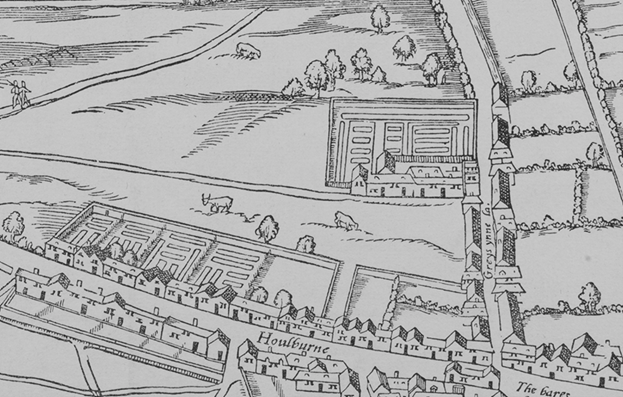
Detail from the map showing Gray’s Inn and surrounding area. Civitas Londinum by Ralph Agas, image source: The London Archives (City of London Corporation). Also known as the Woodcut Map of London, c1561-1570. This edition published c1633. 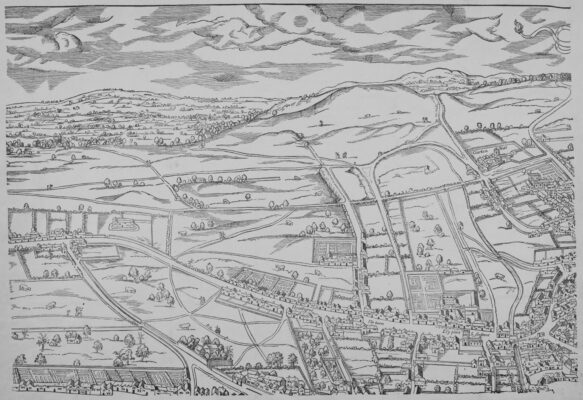
The full Map showing the area around Holborn and Clerkenwell. Civitas Londinum by Ralph Agas, image source: The London Archives (City of London Corporation). Also known as the Woodcut Map of London, c1561-1570. This edition published c1633 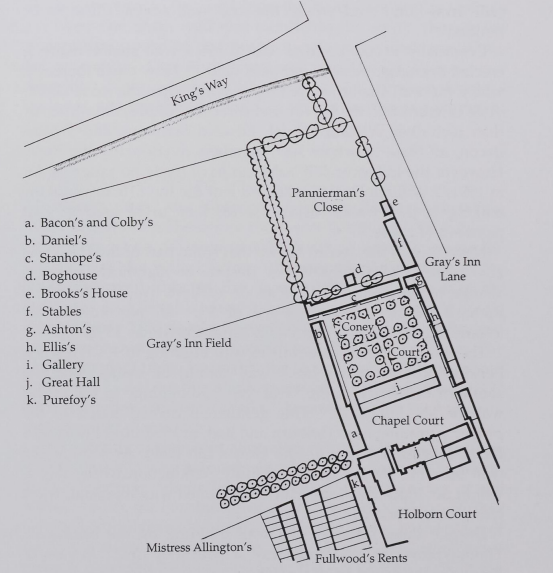
David Jacques reconstruction of Gray’s Inn in 1590, Graya 110 (Michaelmas, 1999). - Order, symmetry and vision in Bacon's Walks design
At the end of the side grounds, I would have a mount of some pretty height, leaving the wall of the enclosures breast high, to look abroad into the fields.
Francis Bacon, ‘Of Gardens’, 1625
Bacon’s design for the Walks introduced order and symmetry. The central avenue of trees, known as the Great Walk, was planted in triple rows – each side included 100 sycamore, 50 beech and 80 elm trees. The layout survives today, but less densely planted, in single rows of American or Northern Red Oaks. For hedging Bacon ordered 2000 quickset and 2000 privet, planted to form compartments and labyrinths, while 1000 woodbine (honeysuckle), 125 roses, vines, pinks and primroses added scent and colour.
The Upper Walk, where you now stand, was formed to view the garden from above and to look out into the countryside. Stairs and rails linked the Upper and Lower Walks, as they still do. The Upper Walk was punctuated halfway along by a mount, topped with a banqueting house, a ‘banquet’ then being a dessert course often served in a decorative garden building. This house was embellished with a carved and gilded griffin, emblem of the Inn and in a Latin inscription Bacon dedicated the banqueting house to the memory of his friend Jeremy Bettenham, an ‘innocent, abstinent and contemplative man.’
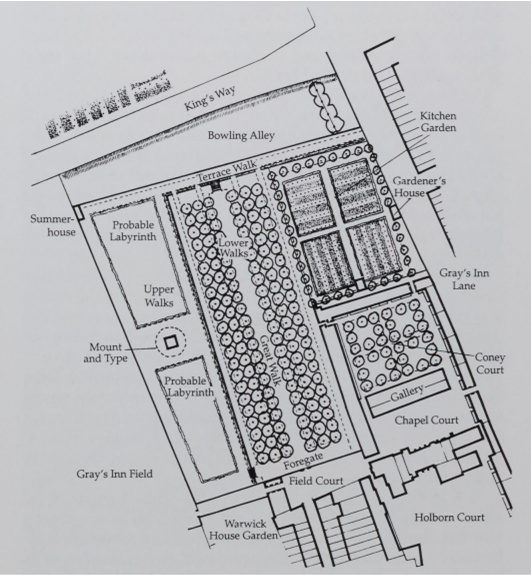
David Jacques reconstruction of Gray’s Inn in 1650, Graya 110 (Michaelmas, 1999). - The biodiverse haven of the Walks today
There ought to be gardens for all months in the year, in which, severally, things of beauty may be then in season.
Francis Bacon, ‘Of Gardens’, 1625
The Walks today are a home to a wide range of flowers, shrubs, hedges and trees from around the globe which creates a biodiverse haven for the many insects, animals and birds which live here or visit. This includes but is not limited to:
Trees
- Avenue of American Red Oaks (1990)
- Whitebeam
- Autumn Flowering Cherry
- Field Maple
- Double White Cherry
- Ash
- Indian Bean Trees (Catalpa)
- Liquidambar
- Wedding Cake Tree
- White Saucer Magnolia ( M.soulangeana)
- London Planes
- Birch Grove
- Persian Ironwood
- Black Tulip Magnolia
- Hawthorn (Lavalle and Broad leaved Cockspur)
- Golden Robinias
- Beech (King’s Coronation Tree)
- Canadian Red Maple and Silver Maple
- Tulip Tree (Platinum Jubilee Tree)
- Black Mulberries
The Orchard (planted in 2009 to a design by ‘Brogdale Fruit Collection’).
On the west upper terrace an Orchard of old fruit varieties includes:
- Apples,
- Quince,
- Medlar,
- Crab Apples,
- Plum,
- Damson
- and Greengage (which the parakeets like to gorge on!)
Swathes of long grass beneath the trees are full of daffodils and tulips in Spring and the blossom in April provides a great source of nectar for the bees.
Long Grass Bank
This large area of long grass is alive with the buzzing of insect life in summer.
In spring naturalised daffodils are followed by colourful magenta pink Byzantine Gladioli.
Border Plantings
Camellia Border This border inside the main gate brings early colour to the garden with the showy pink flowers of Camellia Donation.
Rose Border Shrub roses (Penelope and Buff Beauty) and Climbing roses (Handel and Guinee) flower along the boundary railings in May.
Steps Bank Planting A new scheme of drought tolerant silver leafed planting including Curry Plant and Lamb’s Ear with Sedum, white and mauve Alliums, and Verbena bonariensis has been planted to cope with the drier summers.
Eastern Long Border A deep mixed border is full of seasonal interest including:
Shrubs:
- Turkish Sage (Phlomis) Callicarpa Cotoneaster
- Lilac Ballerina Rose Perennial wallflower (E.mutabile)
- Viburnums Witch-hazel Abelia
- Cotinus Weigelia Wintersweet
- Euphorbia
Perennials:
- Iris Jane Phillips,
- Salvias,
- Verbena bonariensis,
- Fennel,
- Peonies,
- Sisyrinchium,
- Geraniums,
- Cardoons,
- Globe thistle,
- Russian Sage,
- Macleaya,
- Rudbeckia,
- Eupatorium,
- Thalictrum
- and Hellebores.
Biennials:
- Honesty,
- Sweet Rocket
- and Foxgloves
Bulbs
- Snowdrops and crocus
- Grape Hyacinths
- Daffodils
- Tulips
Wildflower
- Pink Campion
- Toad flax
- Ox-eye daisies
- Valerian
- Meadow Sage
- Purple Cow Parsley
- Field Scabious
- Foxgloves
- From bowling to a school playground
If a man will begin with certainties, he shall end in doubts; but if he will be content to begin with doubts, he shall end in certainties. Men must pursue things which are just in present and leave the future to divine providence.
Francis Bacon, The Advancement of Learning, 1605
Inscribed on the Millennium Stele sited here in the late 20th Century, the sculptor was Martin Jennings.
We are now at the north end of the Walks and can look south over the span of the gardens. This top lawn was the Inn’s bowling alley in Bacon’s time. Bowling was a popular and fashionable pastime in the sixteenth century. A number of different games were played in the bowling alley, including nine-pins (sometimes using a thrown stick or ‘kayles’), cones (aiming to roll close to a target), early versions of lawn bowls, and quoits. Part of the fun was betting on the outcome. Many members were avid gamblers, and the Inn’s butlers had a profitable sideline running gaming tables and keeping a cut of the profits.
Gervase Markham in ‘Country Contentments’ (1654) wrote of bowling “A recreation…exceeding wholesome… prescribed for a recreation to great persons…is bowling, in which a man will find great art in choosing out his ground and preventing the winding, hanging and many turning advantages of the same, whether it be in open wide places or in close alleys”.
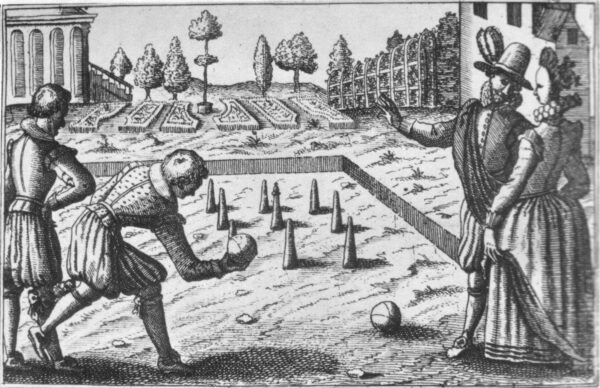
Illustration: Woodcut of bowling in the 16th century, source Wikimedia Commons. This area of the garden is now used by the City Junior School as a playground, which they call The Meadow. Their House Captains write:
“A Meadow is a kind of open field where grass and wild plants are allowed to grow on their own.”
“It isn’t like a park, where everything is cut short and kept tidy, and it isn’t farmland, where things are planted in straight lines. In a meadow, different grasses, flowers and small plants all grow together, mixing and changing, depending on the season. Some are tall, some are small, and some only appear for a short time, before disappearing again.”
“This Meadow has been here for many hundreds of years; growing and changing in its own way. Even when people aren’t’ here, it doesn’t stop. The wind still moves through the grass, insects still live among the stems and flowers still open and close as the days pass. It always has been busy, but just not in a loud way. Now, it is open to us and to the public, which means anyone can come in and see how it works for themselves.”
“At first, it might not seem so special. You might just see grass and a few flowers. But if you look a bit longer, you start to notice more. The tiny details are everywhere: different shapes of leaves, colours that you didn’t even see at first and small creatures moving around, each with their own job. Everything in the Meadow is connected, even if it doesn’t look it.”
“Meadows are important because they give space for many kinds of plants and animals to live. They are places where things are allowed to grow more freely, without being so controlled (a bit like us at playtime!)”
“So, this is not just an empty field. It is a living place, full of tiny changes and quiet activity. Now that the Meadow is open to us, as our playground at City Junior School, we walk through it, stop for a moment, admire and see what has been happening here all along, for all these hundreds of years.”
- A poem: The Gray's Inn Walks
The Gray’s Inn Walks
The Walks is a magical place
It is diverse and for old and young
The Walks – special and full of grace,
Laid by Sir Francis Bacon in 1608, it’s journey just begun.
From the bare ground,
To the lush green leaves
The birds sing a blissful sound
High up in the shelter of the trees
It is a wondrous sight,
The children galloping across the field,
Full of joy and sheer delight,
A new generation of happiness revealed.
Now I must say farewell,
I hope you enjoyed my stay
But this I will be able to tell
The Walks have shown me a new path: I will return again one day.
- Order, discipline and reflection in Bacon's Walks
If a man be gracious and courteous to strangers, it shows he is a citizen of the world, and that his heart is no island, cut off from other lands, but a continent, that joins to them.
Francis Bacon, ‘Of Goodness & Goodness of Nature’, 1625
The gardener lived on site, in a house situated at the far end of the garden. As well as his gardening duties, he had to keep ‘boys, girls, rude and beggarly people’ out of the Walks, and prevent anyone from hanging clothes up to dry on the rails and hedges round the bowling green, while decorum should be observed during chapel services, when the gardener was ‘not to suffer any Gentleman of the House or others to be in the Walks’.
Gardeners were advised to keep ‘all things in a comely convenientness,’ the formality of the garden symbolic of the desire for order and stability in society. They were charged with ‘keeping the earth in order, which else would grow wilde…nothing remaining but a chaos of confusedness.’ Images of gardens were metaphors for social and personal order and disorder.
Francis Bacon habitually paced in gardens while meditating and dictating his thoughts to a secretary. Garden imagery abounds in his works, where enquiry into nature may become a journey through a wood to open ground, while discourses can be entered through a gate and ‘followed in their winding ways to a promontory from which the broad heath beyond the garden walls is suddenly revealed.’ (Francis Bacon, Novum Organum VI, 1620.)
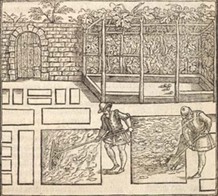
‘Sowing, seeding and weeding’, from Thomas Hill, The Gardener’s Labyrinth, 1594. public domain - An enduring legacy
For my name and memory, I leave it to men’s charitable speeches, to foreign nations, and the next ages
Francis Bacon, Last Will and Testament, 1625
The Inn has had close ties to the monarchy since the reign of Elizabeth I. In Bacon’s time royalty was feted in the Inn with revels and masques, many of which he organised and wrote, including the Masque of Flowers of 1614 attended by James I. Today, King Charles III, Queen Camilla, and the Duke and Duchess of Gloucester are Royal Benchers of the Inn.
As a young man in the train of the English ambassador to France, Francis Bacon undoubtedly saw some of the great gardens that were to influence the late 16th and early 17th Century gardens of England. He knew the fine gardens made by his father Sir Nicholas at the family’s country estate, Gorhambury in Hertfordshire, and by his uncle Lord Burghley at Theobalds. As Bacon’s rise to professional and political power coincided with the expansion of Gray’s Inn, he drew on his longstanding interest in gardens and nature, backed by formidable energy and determination, to create the peaceful retreat that has been enjoyed by Members and visitors to the Inn for over four centuries.
Pre-eminent in the history of English humanist thought, Bacon created a new scientific understanding of nature, pioneered inductive reasoning based on observation and experiment and wrote extensively on aspects of natural history. His essays ‘Of Building’ and ’Of Gardens’ give us much detail about gardens of his time.
Here in the gardens he made, we can picture Bacon in his later years gazing over them from his chambers, content with the transformation he had wrought. His great legacy to Gray’s Inn is the Walks, our shared responsibility is ensuring they thrive for many years to come.