


Our latest Library display looks at the trial of Charles I which took place in Westminster Hall on the 20th of January 1649 – and two former Gray’s Inn Members played major roles in this trial and regicide.
The Trial
The High Court of Justice at Westminster Hall put King Charles I on trial for treason after he raised an army against parliament during the Civil Wars. This was justified on the practical grounds of preventing Charles from raising further rebellions, and on a matter of principle: that the King should have no impunity from the law. Kings had been deposed and murdered but never before tried and condemned to death whilst still King.
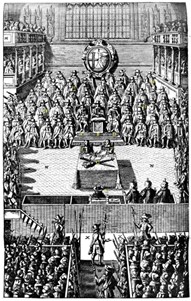
King Charles I was non-compliant during his trial, refusing to accept the authority of the court. He appeared before his judges four times – just seven days later, the judges returned a guilty verdict and passed the sentence of execution. Charles I was executed by beheading on 30 January 1649 at the Palace of Whitehall.
Act of Indemnity and Oblivion
With the Restoration of the Monarchy in May 1660, an Act of Indemnity and Oblivion was passed to pardon the majority of those who had committed crimes in the intervening period, although there were notable exceptions; those involved in the trial and execution of Charles I were tried for treason.
Gray’s Members:
John Cook
John Cook was a Member of Gray’s Inn and led the prosecution of the King. Alongside taking part in the trial, Cook was a significant lawyer for several other reasons. He defended John Lilburne the Leveller, in a case that established the right to silence. He is also credited with establishing the cab-rank rule for lawyers. 
As Cromwell’s solicitor general, he drafted the Act which abolished the monarchy and the House of Lords. Cook was key to one of the trial’s central images, of the King bowing before the law:
“Charles refused to plead, on the basis that as God’s anointed, he had the purest form of sovereign immunity and hence the court summoned to try him was unlawful. When prosecutor John Cook began to read the indictment, the King tried to stop him with a poke of his cane: its ornate silver tip fell off, and Cook refused to pick it up. There was a dramatic pause, then the King stooped low to retrieve it himself – the portentous historical moment when the divine majesty bowed, powerless before the majesty of human law.” (Robertson, 2002, p.5)
After the Restoration, Cook was excluded from the Act of Indemnity and Oblivion and executed as a regicide.
John Bradshaw
John Bradshaw, Member of Gray’s Inn, was appointed Chief Judge for the trial of Charles I – only 68 out of 135 Judges had turned up. Bradshaw seemed initially reluctant to hold the position, not appearing in court until the third session, and in court itself he was protected by a bodyguard, armour under his scarlet robes and a wide bullet-proof hat.
He did not allow the King any final words. Under English law, a condemned prisoner was no longer alive and therefore did not have the right to speak, and Bradshaw followed this tradition strictly. On his deathbed Bradshaw said that if called upon to try the King again he would be “the first man in England to do it”. 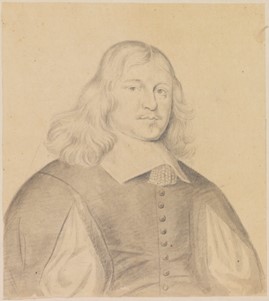
Bradshaw was one of the three people to be exhumed by Charles II during the restoration for “posthumous execution”. His body was hanged and beheaded, and his severed head was displayed at Westminster Hall, facing towards where the King had been executed, alongside those of Oliver Cromwell and Henry Ireton.
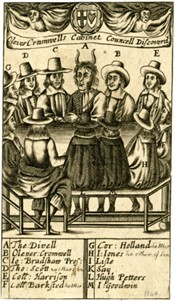
This illustration on the left, in which the devil sits with eleven men closely involved in the King’s trial and execution, was printed in a satirical book from the 1660s after the monarchy was restored. Figure C, by the devil’s right hand, is Gray’s Inn Member John Bradshaw – the Judge for the trial.
Find out more by visiting our Library display!